
Peach Grove. 2023. Peach-scented toilet paper, toothpicks. 50 x 50 ft.

Peach Grove. 2023. Peach-scented toilet paper, toothpicks. 50 x 50 ft.

Tick. 2023. Mixed media. 31 x 41 in.

Cornerstone. 2024. Peach-scented toilet paper, beeswax. 16 x 16 in.
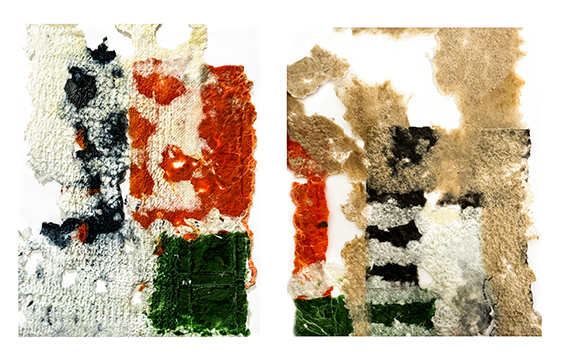
Supporting Silence. 2024. Paper, beeswax. 8 x 10 in. Collaboration with Aramo Olaya and Gino Robair.
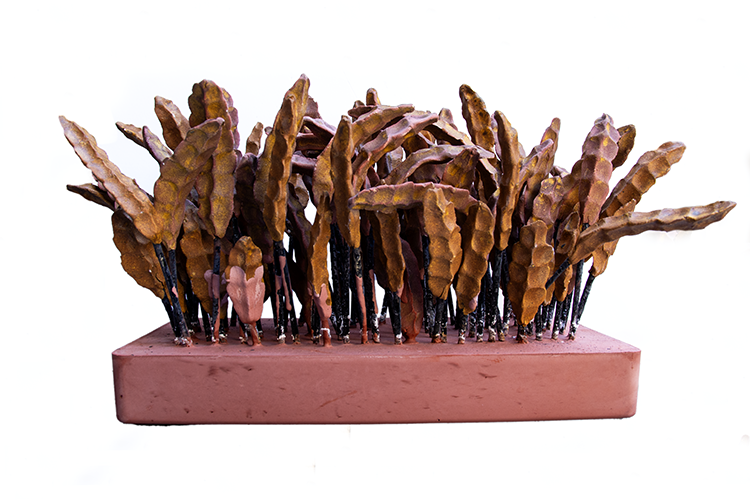
Parcel. 2024. Clay, red iron oxide, rutile, hydrostone. 12x8x8 in.

Parcel. 2024. Clay, red iron oxide, rutile, hydrostone. 12x8x8 in.
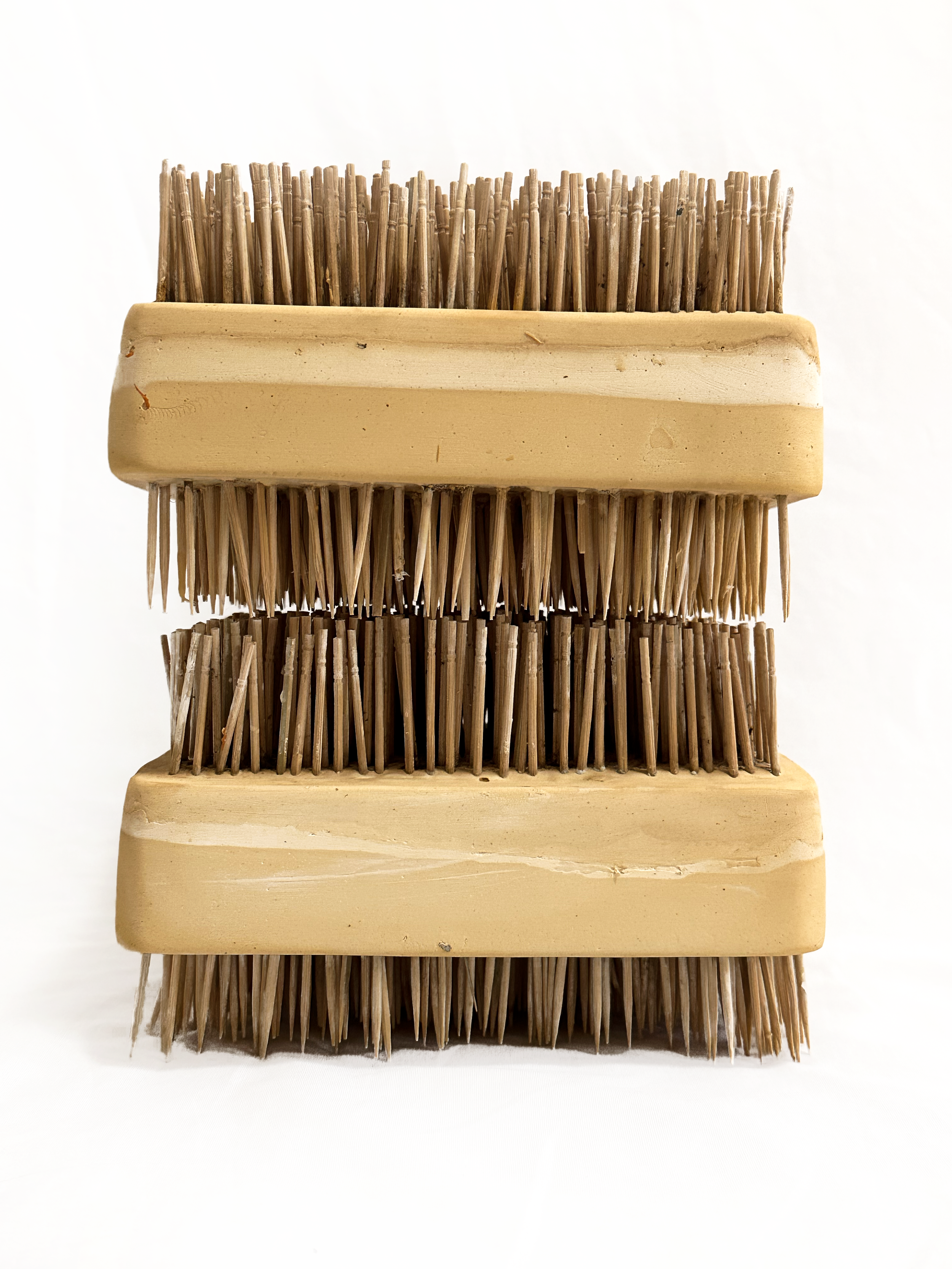
hay bale. 2024. toothpicks, hydrocal, golden ambrosia stain. 6x6x9 in.
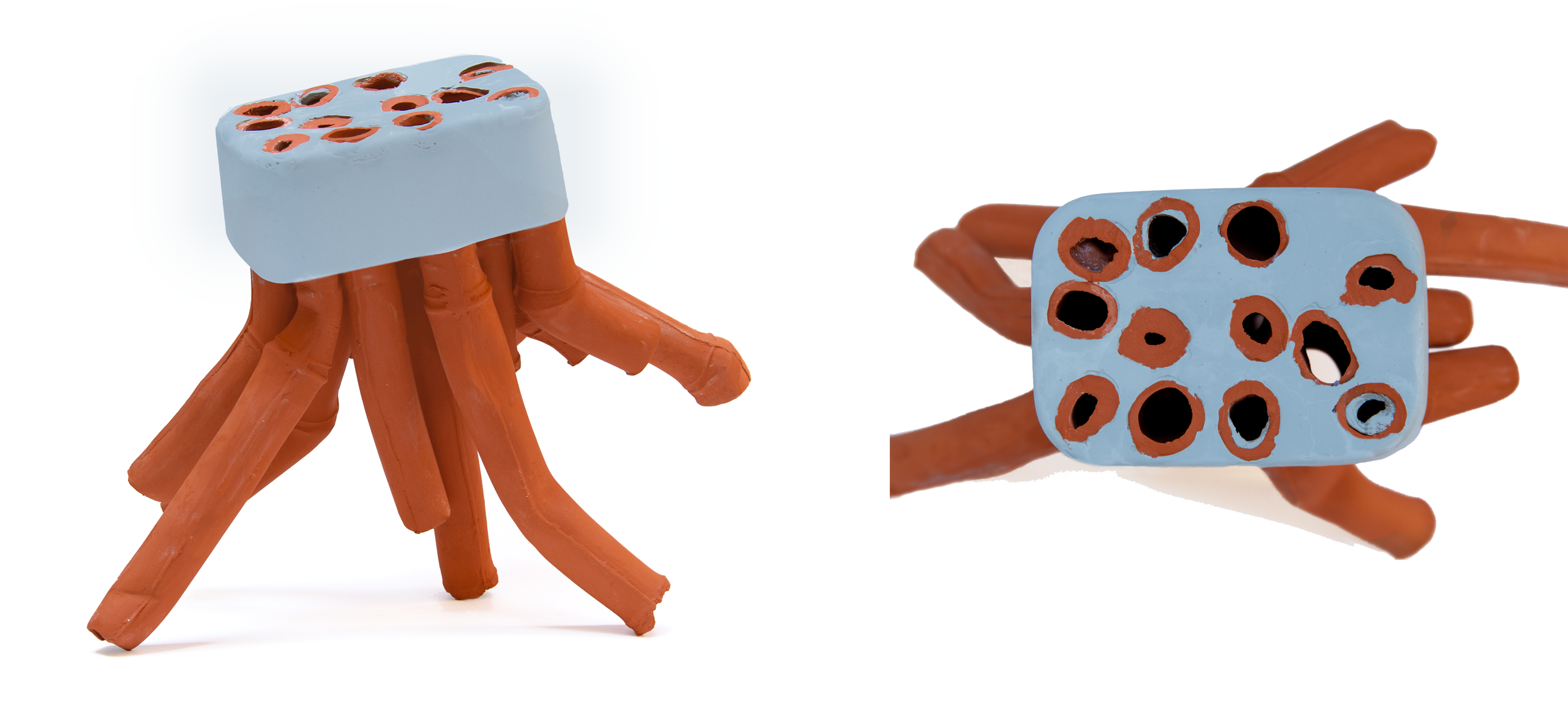
water line 1. 2024. Clay, hydrocal, shadow grey stain.
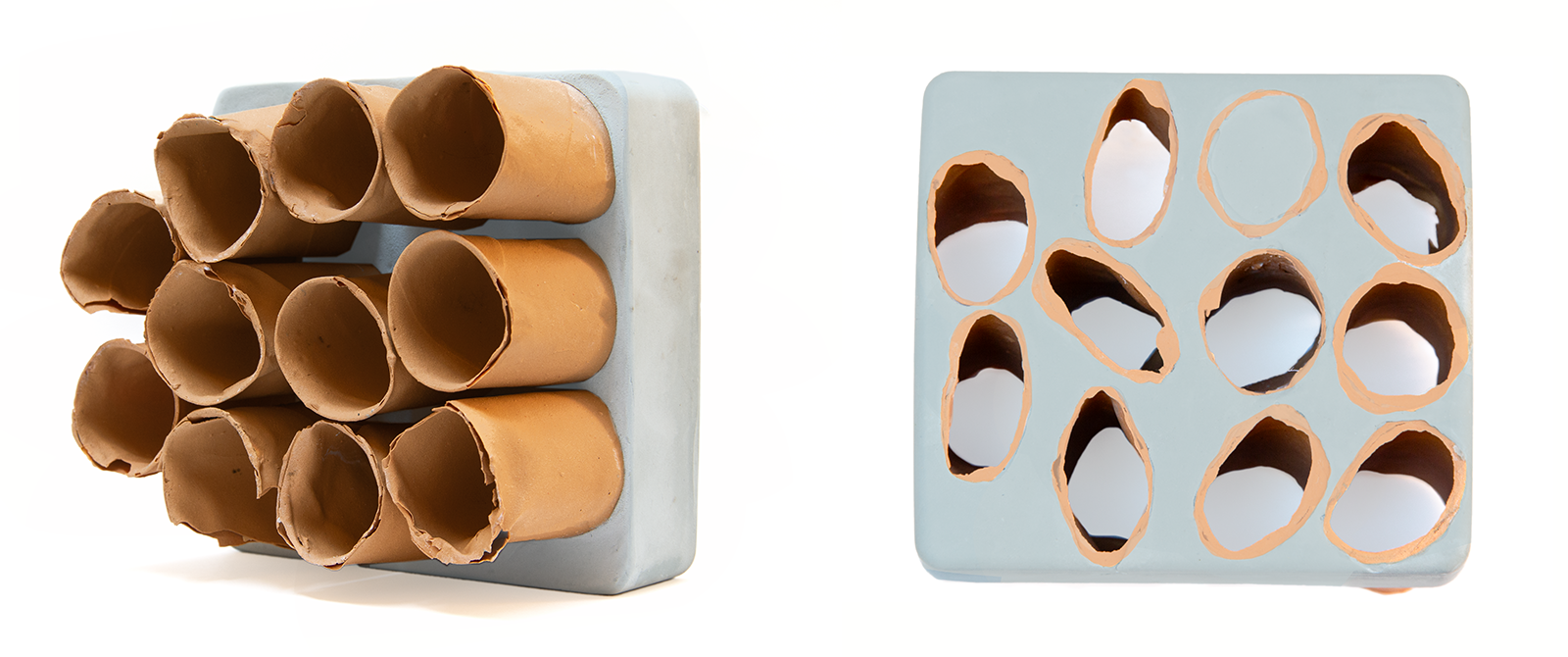
water line 2. 2024. Clay, hydrocal, shadow grey stain, golden ambrosia stain, saturn orange stain.
In Peach Grove, I plant squares of peachy toilet paper—peach dyed and peach scented—in the ground, arranging them one after another in a grid that echoes the organization of industrial agriculture. I plant the peaches, moving from one square to the next as the grid grows across the ground. The repetitive labor pushes my body toward exhaustion. Artificial peach perfumes leach from the toilet paper into my skin. I have an allergic reaction. I am covered in hives. A grove is inherently a gathering, a breathing ecosystem of trees that exists through space and rhythm. Its growth creates changing relations between shadow and light. Beneath the soil, tree roots extend toward and intertwine with one another, while above, foliage and fruit interlace into a shared canopy. The grid organizes individual squares and the labor of planting them, while the grove draws my attention toward what grows across, beneath, and beyond those divisions. Through planting, the peachy squares enter into these relations with soil, bodies, plants, air, moisture, scent, and each other. Grove attends to the possibility of a grove as a sanctuary, a stage, a threshold, and a story—a relational holding of the earth’s liveliness and the rhythms it sustains.
Peach Grove. Performance. Peach-scented toilet paper, toothpicks. 50 x 50 ft. Russell Field, Davis, California, 2023. Made possible with the funding support of the Performance Studies Graduate Group at the University of California Davis.
irvin, em. “Peach Grove.” Global Performance Studies 6, no. 1–2 (2023).
Tick. 2023. Mixed media. 31 x 41 in.
Trip to the Future: A Zine on Fiction, Disability, and Speculation. Buzz Zine, Volume III. Behives.
Participants surround me in the round as I sit on a bucket over plastic, waiting to receive. An audiovisual score plays on a loop, demonstrating various ways of forming clay into a vessel and guiding participants to follow the movements with clay in their own hands. Clay prepares to receive the form of a vessel. Bodies lie together. Approach. Offer one to your hands.
Preparation to receive involves muscular coordination of the hands: squeezing, opening, contracting, and expanding as clay molds into a rounded shape, filling the hollow of the palms. Hands open and suspend clay, creating a momentum of rolling, rounding, and rotating—a loop, a rhythmic choreography. Pressure between hands is just enough to shape, compress, and keep the clay in motion without flattening or distorting it beyond the image of a sphere. Participants cradle clay within a network of interlaced fingers, weaving one hand’s fingers as intentional weft into the other’s. The crowns of the thumbs meet. This flexible net supports the clay’s outer form as thumbs press deeply into the center. Thumbs slide out, the clay turns, and the movement repeats. The elbow, the knee, and the heel offer other parts of the body capable of forming vessel space. Participants are encouraged to try with different bodies, impressing clay onto body contours and inviting the warmth and tremor of the body to form clay and clay to form its reciprocal image.
Vessels need walls to sustain their holding potential. Hands pinch these walls, speaking to one another in a coordinated rhythm around and through form. Touch allows hands to feel wall thickness and consistency as they pinch. One hand offers a hollow for the clay vessel while the other moves around its walls. The pointer finger’s knife edge compresses the rim. A fingertip or thumb pad smoothes the vessel’s sides, pressing the rim to echo the lips as they meet the mouth’s inner edge.
The vessel is prepared.
Participants carry their vessels toward water held with readiness. They dip the clay into water in an angular descent. Fill. Following the movements and voiced instructions of the score, they carry this nurturing element toward a mouth—my mouth. I remain seated at the center of the surrounding bodies, waiting to receive. Participants bring the vessels they have formed to my lips and offer me the water to drink.
As the score repeats, water passes through and against unfired clay. Clay passes into the water. Participants continue to form vessels, collect water, carry it across the space between their bodies and mine, and offer it to my mouth. What I receive is increasingly clay water. The vessel carries water while water carries clay toward my body.
Return clay to the bucket to prepare again.
The score repeats in a loop for the duration of the performance: clay prepares to receive the form of a vessel; the vessel prepares to receive water; I sit surrounded by participants preparing to receive their offering. Clay passes among bucket, hands, vessel, water, and mouth as participants repeatedly form, fill, carry, and feed.
Feed. Participatory performance. Practice as Research Performance Salon (P.a.R.P.S.), Mondavi Center for the Performing Arts, Davis, California, 2023. Sounds created with the assistance of Ryan Danley.